Relevant Excerpt from the Study Abstract:
Methods. In this population-based study, we used administrative data from the Michigan Department of Health and Human Services for all births in the state of Michigan, USA, and a quasi-experimental study design. Our study population comprised all infants born from Jan 1, 2021, to June 30, 2025, to women aged 16 years and older. The primary outcomes were preterm birth (<37 weeks) and low birthweight (<2500 g). Secondary outcomes included small for gestational age, admission to the neonatal intensive care unit, smoking in the third trimester, and prenatal care adequacy. We used a difference-in-differences strategy to estimate the adjusted mean change for the outcomes in Flint after implementation of Rx Kids relative to changes in a comparison group of matched cities. We also assessed several subgroups and the underlying assumptions of our difference-in-differences strategy.
Findings. In 2021–23, the 3 years before the implementation of Rx Kids, 15.1% (445 of 2940) of births in Flint were preterm and 15.8% (465 of 2943) were low birthweight. Relative to the matched cities, Rx Kids was associated with a decrease in the preterm birth rate by 2.7 percentage points (95% CI –4.6 to –0.8; p=0.0075) and in the proportion of infants born with low birthweight by 4.2 percentage points (–6.0 to –2.4; p<0.0001). Corresponding to these reductions, Rx Kids was associated with fewer admissions to the neonatal intensive care unit by 4.4 percentage points (–6.5 to –2.4), less smoking in the third trimester (–1.7 percentage points [–2.4 to –0.9]), and more adequate prenatal care (5.7 percentage points [1.8 to 9.7]). The improvements in low birthweight, very low birthweight, very preterm, smoking in the third trimester, and prenatal care adequacy were most robust to alternative model specifications. The estimates for the primary outcomes were larger in magnitude for women who were non-Hispanic Black, nulliparous, and insured by Medicaid.
Interpretation. With significant reductions in adverse birth outcomes, the treatment of perinatal poverty with a place-based intervention as replicable and scalable as Rx Kids has important implications for infants and society. These findings suggest that the economic hardship of the perinatal period, starting in utero, contributes to adverse outcomes and is addressable.
Methods. In this population-based study, we used administrative data from the Michigan Department of Health and Human Services for all births in the state of Michigan, USA, and a quasi-experimental study design. Our study population comprised all infants born from Jan 1, 2021, to June 30, 2025, to women aged 16 years and older. The primary outcomes were preterm birth (<37 weeks) and low birthweight (<2500 g). Secondary outcomes included small for gestational age, admission to the neonatal intensive care unit, smoking in the third trimester, and prenatal care adequacy. We used a difference-in-differences strategy to estimate the adjusted mean change for the outcomes in Flint after implementation of Rx Kids relative to changes in a comparison group of matched cities. We also assessed several subgroups and the underlying assumptions of our difference-in-differences strategy.
Findings. In 2021–23, the 3 years before the implementation of Rx Kids, 15.1% (445 of 2940) of births in Flint were preterm and 15.8% (465 of 2943) were low birthweight. Relative to the matched cities, Rx Kids was associated with a decrease in the preterm birth rate by 2.7 percentage points (95% CI –4.6 to –0.8; p=0.0075) and in the proportion of infants born with low birthweight by 4.2 percentage points (–6.0 to –2.4; p<0.0001). Corresponding to these reductions, Rx Kids was associated with fewer admissions to the neonatal intensive care unit by 4.4 percentage points (–6.5 to –2.4), less smoking in the third trimester (–1.7 percentage points [–2.4 to –0.9]), and more adequate prenatal care (5.7 percentage points [1.8 to 9.7]). The improvements in
the primary outcomes were sensitive
low birthweight, very low birthweight, very preterm, smoking in the third trimester, and prenatal care adequacy were most robust to alternative model specifications,
underscoring the need to confirm the study's findings in future research.
The estimates for the primary outcomes were larger in magnitude for women who were non-Hispanic Black, nulliparous, and insured by Medicaid.
Interpretation. With significant
possible
reductions in adverse birth outcomes, the treatment of perinatal poverty with a place-based intervention as replicable and scalable as Rx Kids has
may have
important implications for infants and society. These findings suggest that the economic hardship of the perinatal period, starting in utero, contributes to adverse outcomes and is addressable.
No-Spin’s Study Overview
Quasi-experimental study of Rx Kids, a program providing expectant mothers in Flint, Michigan with unconditional cash transfers, reports reductions in preterm birth and low birthweight, but these findings are highly dependent on the analysis methods used – underscoring the need for confirmation in a more rigorous study (e.g., a well-designed randomized controlled trial).
Program:
- From January 2024 to June 2025, Rx Kids provided every expectant mother in Flint, Michigan with $1,500 during pregnancy and $500 per month for 12 months after birth, with no conditions on how the money could be spent.
Study Design:
- The study compared outcomes for the 4,490 births in Flint from January 2021 to June 2025 (i.e., the program period and three preceding years) to the 29,473 births in a comparison group of 21 matched cities in Michigan during the same time period.
- The analysis method that the study used to compare birth outcomes in Flint to those in the comparison group (“difference-in-differences”) assumes that, absent Rx Kids, Flint’s outcomes would have followed a similar trajectory to those in the comparison group (the "parallel trends" assumption).
- However, the authors found evidence of non-parallel trends between Flint and the comparison group in the pre-program period. Therefore, they used statistical methods to try to adjust for the differing trends (they "controlled for linear group-specific time trends”).
Findings on the Primary Outcomes:
- Based on the above analysis, the study found that Rx Kids was associated with a 2.7 percentage point decrease in the preterm birth rate and a 4.2 percentage point decrease in the proportion of infants born with low birthweight. Both impact estimates were statistically significant (p<0.01).
- However, as the authors report in the appendix, when they used an alternative analysis method (“Synthetic Difference-in-Differences,” or SDID) – the same method they use in a separate paper to estimate Rx Kids’ effects on child maltreatment – they found no discernible impact on preterm birth. The impact on low birthweight, while still statistically significant, was less than half as large (2.0 versus 4.2 percentage points).
- In addition, a separate analysis1 by another researcher, using SDID with different comparison cities in Michigan and a different time period (2019-2024), found no discernible impact on either outcome in the program’s first year (2024). This contrasts with the study authors’ finding of “a large and absolute decrease starting in 2024” in preterm birth and low birthweight.
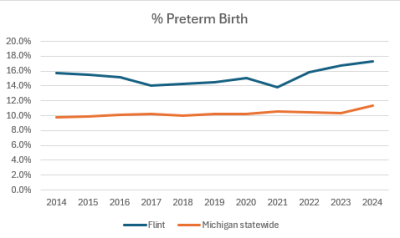
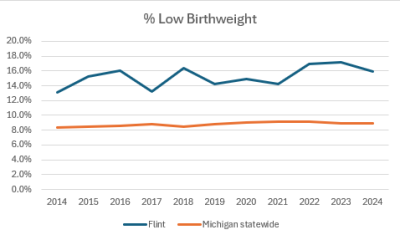
- Our visual inspection of adverse birth outcomes in Flint over a longer time period (2014-2024), based on data from Michigan Health Statistics, reveals substantial year-to-year variation and no obvious improvement in Flint in 2024 (see graphs below). It would be valuable to know whether the study's estimated effects would have stood out from the normal year-to-year fluctuations in birth outcomes had its analysis included more pre-program years (prior to 2021).
Comments:
- The authors didn’t publicly preregister their primary analysis methods - a best practice designed to prevent researchers from, consciously or unconsciously, making post-hoc analysis decisions that favor a particular result. Preregistration is especially important in a quasi-experimental study like this, where different analysis decisions (e.g., choice of comparison cities, time periods, and statistical methods for comparing treatment and comparison groups) yield very different results, and where the authors include the founder and director of the program being evaluated (Rx Kids).
- Michigan recently began a major expansion of Rx Kids across the state, backed by a $270 million state investment over three years. We urge the state to incorporate a well-designed randomized controlled trial into the expansion – as has been done with other unconditional cash transfer programs (here and here) – in order to build more credible evidence about the program’s effectiveness.
1. The faculty advisor on this analysis, Jason Baron, is no relation to Jon Baron of the Coalition for Evidence-Based Policy, who helped draft this No-Spin report.
Click or tap a highlight to see No-Spin’s comment