This paper examines the impact of a large, randomized cash transfer on parental behaviors, investment in children, children's social, behavioral, and educational outcomes, and pregnancy and childbearing. We find that parents who were randomly selected to receive a $1,000 per month unconditional cash transfer for three years spent more on their children each month and reported better parenting behaviors (such as supervising their children more closely) compared to those randomized to receive $50 per month over the same period. However, possibly due to this closer monitoring, parents in the treatment group also reported that their child was experiencing more developmental difficulties and stress. Parents with the lowest incomes at baseline experienced the largest improvements in parenting; among these parents, the transfer also increased the use and quality of non-parental child care. The transfer did not have a meaningful effect on most educational outcomes measured in school administrative records, nor did it affect characteristics of the home environment, child food security, exposure to homelessness, or parental satisfaction. Although treated families were more likely to move, we did not detect changes in most measures of neighborhood quality, though proximity to child-focused amenities such as daycares appeared to increase in the treatment group relative to the control group. The transfer did not affect childbearing, pregnancy, or outcomes related to contraception. While the transfer reduced parents' stress and mental distress in the first year of the program, these effects were short-lived and dissipated by the second year of the transfer, analogous to what was documented previously in the full population of participants.
This paper examines the impact of a large, randomized cash transfer on parental behaviors, investment in children, children's social, behavioral, and educational outcomes, and pregnancy and childbearing. After adjusting for multiple comparisons, we find no statistically significant effects on any of the family-level (composite) outcomes that we had prespecified as “top tier” – which comprise the most reliable findings in the paper. These family-level outcomes include, for example, parenting behavior and investments in children, child stress and social development, and child K-12 educational outcomes. Our analyses of specific components and outcomes within each family produced suggestive findings that may be worth examining in future studies. For instance, we find that parents who were randomly selected to receive a $1,000 per month unconditional cash transfer for three years spent more on their children each month and reported better parenting behaviors (such as supervising their children more closely) compared to those randomized to receive $50 per month over the same period. However, possibly due to this closer monitoring, parents in the treatment group also reported that their child was experiencing more developmental difficulties and stress. Parents with the lowest incomes at baseline experienced the largest improvements in parenting; among these parents, the transfer also increased the use and quality of non-parental child care. The transfer did not have a meaningful effect on most educational outcomes measured in school administrative records, nor did it affect characteristics of the home environment, child food security, exposure to homelessness, or parental satisfaction. Although treated families were more likely to move, we did not detect changes in most measures of neighborhood quality, though proximity to child-focused amenities such as daycares appeared to increase in the treatment group relative to the control group. The transfer did not affect childbearing, pregnancy, or outcomes related to contraception. While the transfer reduced parents' stress and mental distress in the first year of the program, these effects were short-lived and dissipated by the second year of the transfer, analogous to what was documented previously in the full population of participants.
No-Spin’s Study Overview
High-quality RCT of an unconditional cash transfer program in Texas and Illinois, providing low-income individuals with $12,000 per year for three years, finds no discernible impacts on any of the study’s "top-tier" outcomes related to parenting and children over three years.
Program and Study Design:
- The study randomly assigned 3,000 low-income individuals to (i) a treatment group that received $12,000 per year in cash transfers for three years, or (ii) a control group that received nominal cash transfers ($600 per year for three years).
- $12,000 per year is a very sizable cash transfer, equal to more than one-third of sample members' average annual household income prior to the program.
- This report analyzed outcomes for the 1,976 sample members with children in their household. These sample members averaged 31 years of age; 33% were Black, 24% were Hispanic, and 43% were White; and their average household income was $33,000 prior to the program.
- Based on careful review, this was a high-quality RCT (e.g., large sample, baseline balance, minimal sample attrition).
Findings over the three years after program entry:
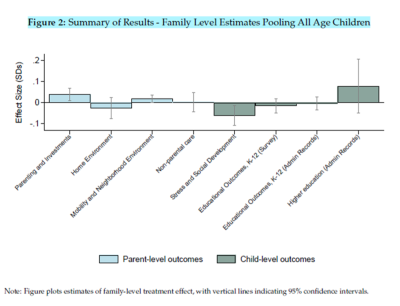
- The study found no statistically significant effects (after adjusting for the possibility of false discoveries) on any of the family-level, composite outcomes that the authors had prespecified as “top tier” – which comprise the most reliable findings in the paper. These composite outcomes are:
- Parenting behavior and investments in children, including outcomes such as parental involvement and positive parenting, expenditures on children, frequency of reading to children, and parental satisfaction.
- Children’s home environment, including outcomes such as child food insecurity and parent homelessness.
- Mobility and neighborhood environment, including outcomes related to moving to higher quality neighborhoods.
- Non-parental care, including outcomes such as use of childcare and quality and stability of childcare (measured for the 811 sample members with children under five years old).
- Child stress and social development, including outcomes such as parental reports on children’s social and emotional development.
- K-12 educational outcomes, survey, including parent-reported outcomes such as school absences, child grades, and disciplinary actions.
- K-12 educational outcomes, administrative records, including outcomes such as attendance, grade retentions, and test scores.
- Higher education, administrative records, including outcomes such as full-time college enrollment or degree completion (measured for the 621 children aged 16 or older at any point during the three-year program).
- As shown in the following figure, the overall pattern of non-statistically significant effects favored neither the treatment nor control group:
Comment:
- The study has previously reported the program’s effects on employment-related outcomes, health-related outcomes, and household consumption and financial health-related outcomes. The abstracts of these earlier reports provide a mostly accurate summary of the findings.
Click or tap a highlight to see No-Spin’s comment