Relevant Excerpts from the Study Abstract:
RESULTS: High- and medium-risk model intervention beneficiaries (n = 130 578) and standard care control beneficiaries (n = 88 286) were similar in age (median age, 72-73 y), sex (58%-59% men), race (7%-8% Black), and baseline CVD risk score (median, 24%). The probability of a first-time CVD [cardiovascular disease] event within 5 years was 0.3 percentage points lower for intervention beneficiaries than control beneficiaries (3.3% relative effect; adjusted hazard ratio [HR], 0.97 [90% CI, 0.93-1.00]; P = .09). The 5-year probability of combined first-time CVD events and CVD deaths was 0.4 percentage points lower in the intervention group (4.2% relative effect; HR, 0.96 [90% CI, 0.93-0.99]; P = .02). Medicare spending for CVD events was similar between the groups (effect estimate, −$1.83 per beneficiary per month [90% CI, −$3.97 to −$0.30]; P = .16), as was overall Medicare spending including model payments (effect estimate, $2.11 per beneficiary per month [90% CI, −$16.66 to $20.89]; P = .85).
RESULTS: High- and medium-risk model intervention beneficiaries (n = 130 578) and standard care control beneficiaries (n = 88 286) were similar in age (median age, 72-73 y), sex (58%-59% men), race (7%-8% Black), and baseline CVD risk score (median, 24%). There were no statistically significant differences between intervention beneficiaries and control beneficiaries on any of the five primary outcomes. A near-significant trend favored the intervention group on one of the outcomes: Among high and medium risk beneficiaries, the probability of a first-time CVD [cardiovascular disease] event within 5 years was 0.3 percentage points lower for intervention beneficiaries than control beneficiaries (3.3% relative effect; adjusted hazard ratio [HR], 0.97 [90% CI, 0.93-1.00]; P = .09). In a post-hoc exploratory analysis, the 5-year probability of combined first-time CVD events and CVD deaths was 0.4 percentage points lower in the intervention group (4.2% relative effect; HR, 0.96 [90% CI, 0.93-0.99]; P = .02). Medicare spending for CVD events was similar between the groups (effect estimate, −$1.83 per beneficiary per month [90% CI, −$3.97 to −$0.30]; P = .16), as was overall Medicare spending including model payments (effect estimate, $2.11 per beneficiary per month [90% CI, −$16.66 to $20.89]; P = .85).
CONCLUSIONS AND RELEVANCE: The Million Hearts Model, which encouraged and paid for CVD risk assessment and reduction,
did not produce significant improvements in the five primary targeted health and healthcare cost outcomes. A near-significant trend on one of the outcomes (first-time CVD events among high- and medium-risk beneficiaries) may warrant examination in future research.
reduced first-time MIs and strokes. Results support guidelines to use risk scores for CVD primary prevention.
No-Spin’s Study Overview
Generally well-conducted RCT of Million Hearts Model, a federally-sponsored, national pay-for-performance project designed to prevent heart attacks and strokes and reduce healthcare spending among Medicare patients, finds no statistically significant effects on the study's primary outcomes at the 4-5 year follow up.
Program:
- Per the 2022 program report: “In 2017, the Centers for Medicare & Medicaid Services (CMS) launched the Million Hearts® Cardiovascular Disease (CVD) Risk Reduction Model. In this pay-for-prevention model, CMS pays participating [healthcare provider] organizations (1) for assessing each of their eligible Medicare fee-for-service (FFS) beneficiary’s risk of having a heart attack or stroke over the next 10 years and (2) for reducing CVD risk among high-risk beneficiaries.”
- “The goal of the model is to reduce the incidence of first-time heart attacks and strokes among Medicare FFS beneficiaries and to reduce Medicare spending enough to fully offset model payments.”
Study Design:
- The study randomly assigned 516 organizations across the US (primary care and specialty practices, health centers, and hospital outpatient departments) to a treatment group that implemented the Million Hearts Model versus a control group that continued usual care. Over two years, these organizations enrolled a sample of 218,864 patients who were at high or medium CVD risk.
- Over the five-year project, CMS made $7.2 million in pay-for-performance payments to treatment group organizations as part of the study.
- Based on our review criteria, the study was generally well conducted.
Findings:
- The study found no statistically significant effects on any of its five reported primary outcomes at the 4-5 year follow-up. (The findings are reported in both the JAMA article and the Final Evaluation Report submitted to CMS by Mathematica Inc.)
- Specifically, the study found no significant effects on:
- The rate of first-time heart attacks and strokes among high-risk patients (the rates were 10.6% in the treatment group versus 10.7% in the control group, p=0.63).
- The rate of first-time heart attacks and strokes among high- and medium risk patients (7.8% treatment versus 8.1% control). This effect approached statistical significance (p=0.09).
- Average Medicare spending per month on first-time CVD events among high-risk-patients ($53 treatment vs. $56 control, p=0.23).
- Average Medicare spending per month on first-time CVD events among high- and medium-risk patients ($39 treatment vs. $41 control, p=0.16).
- Average total Medicare Part A and B spending per month among high- and medium-risk patients ($956 treatment versus $955 control, p=0.94).
- The rate of first-time heart attacks and strokes among high-risk patients (the rates were 10.6% in the treatment group versus 10.7% in the control group, p=0.63).
Comment:
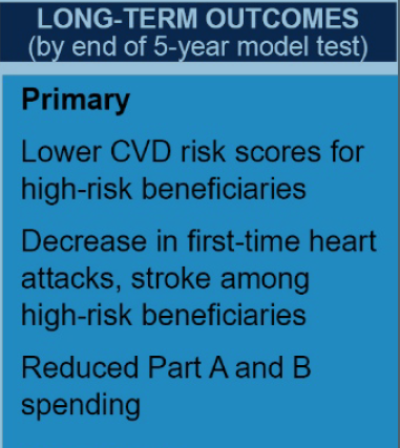
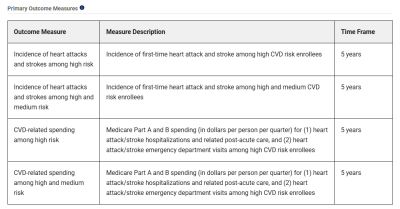
- A clarifying note on the primary outcomes: The study authors prespecified three primary outcomes in the project's first annual report (February 2019, p. 6, see first box below, in blue) and four primary outcomes on clinicaltrials.gov (August 2019, see second box below). One outcome is the same across both prespecifications (first-time heart attacks and strokes among high-risk beneficiaries), and findings are not reported for another outcome (CVD risk scores for high-risk beneficiaries at the 5-year mark). Our summary above presents findings for all five remaining primary outcomes.
Click or tap a highlight to see No-Spin’s comment