A promising way to mitigate inequality is by addressing students’ worries about belonging. But where and with whom is this social-belonging intervention effective? Here we report a team-science randomized controlled experiment with 26,911 students at 22 diverse institutions. Results showed that the social-belonging intervention, administered online before college (in under 30 minutes), increased the rate at which students completed the first year as full-time students, especially among students in groups that had historically progressed at lower rates. The college context also mattered: The intervention was effective only when students’ groups were afforded opportunities to belong. This study develops methods for understanding how student identities and contexts interact with interventions. It also shows that a low-cost, scalable intervention generalizes its effects to 749 4-year institutions in the United States.
A promising way to mitigate inequality is by addressing students’ worries about belonging. But where and with whom is this social-belonging intervention effective? Here we report a team-science randomized controlled experiment with 26,911 students at 22 diverse institutions.
Contrary to our hypothesis,
results showed that the social-belonging intervention, administered online before college (in under 30 minutes),
did not discernibly
increased the rate at which students completed the first year as full-time students
among students in groups experiencing a lower sense of belonging at their chosen college. In exploratory analyses, we find that the intervention may have increased first-year full-time completion
especially among students in groups that had historically progressed at lower rates,
but
the college context also mattered: The intervention was
appeared
effective only when students’ groups were afforded opportunities to belong. This study develops methods for understanding how student identities and contexts interact with interventions. It also shows that a low-cost, scalable intervention generalizes its effects to 749 4-year institutions in the United States.
No-Spin’s Study Overview
Large, high-quality RCT of a brief online reading-and-writing activity to promote “social belonging” among first-year students at 22 U.S. colleges finds null effects on one of its prespecified hypotheses – that the intervention would increase college persistence among students in groups with a low sense of belonging – and doesn’t report findings on its other two prespecified hypotheses.
Program and Study Design:
- The social belonging intervention was a 10–30-minute web-based reading-and-writing activity for incoming first-year college students, designed to address their worries about belonging.
- The researchers randomly assigned nearly 27,000 students across 22 diverse U.S. colleges to receive the social belonging intervention (treatment) or an unrelated writing exercise (control).
- Based on our review criteria, this was a high-quality RCT.
Findings:
- In the study’s preregistered analysis plan (excerpted below), the researchers hypothesized that the intervention would be effective for three subgroups: (i) societally disadvantaged students (defined as Black, Latino, Native, or Other-race students and first-generation college students of any race-ethnicity), (ii) students in identity groups experiencing “higher threat” on campus (e.g., fear of being stereotyped based on race or social class); and (iii) students in identity groups experiencing a lower sense of belonging on campus.
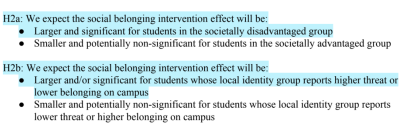
- The study found no discernible effect on first-year full-time college completion for one of these subgroups – students in groups experiencing lower belonging on campus – and doesn’t report findings for the other two hypothesized subgroups.
- In exploratory analyses (not testing a preregistered hypothesis), the study found possible effects on first-year full-time completion among students in groups that had historically progressed at lower rates on their campus, but only when these groups were afforded opportunities to belong on campus. These findings may warrant examination in future research.
Click or tap a highlight to see No-Spin’s comment